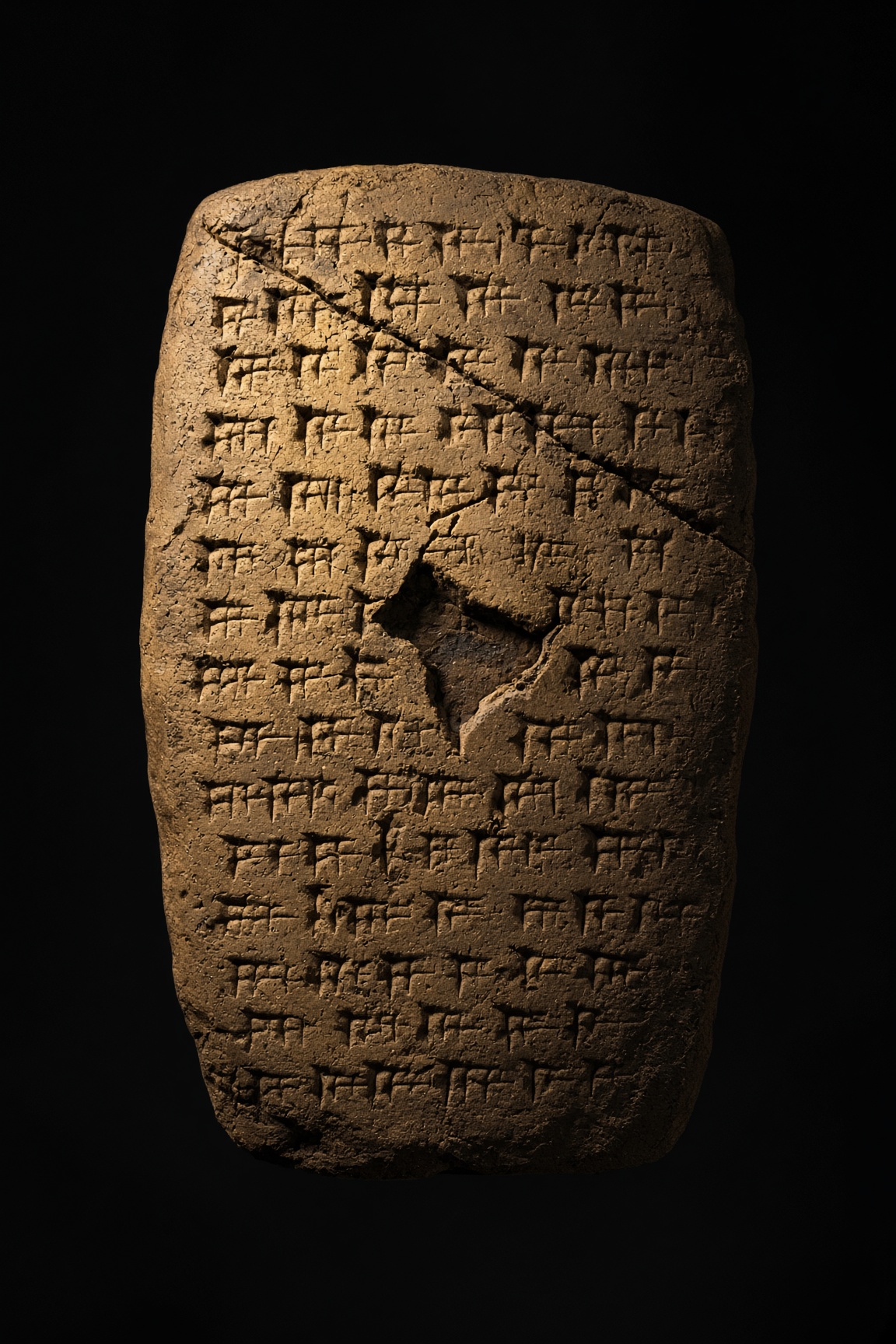
A Sumerian story, witnessed here on Old Babylonian clay from Nippur.
CBS 6894 breaks at the end of the descent.
But before we ask what a story means, what happens when we encounter the story itself?
Inana's descent to the nether world.
ku₃ ᵈinanna-ke₄ na-am₂-mu-ud-na-na-še₃ er₂-gig i₃-še₈-še₈
Holy Inana wept bitterly for her husband.
ETCSL marks the next four lines as fragmentary.
From the great heaven she set her mind on the great below.
Open up, doorman, open up. Open up, Neti, open up. I am all alone and I want to come in.
Holy Inana answered him: "Because Lord Gud-gal-ana, the husband of my elder sister holy Ereškigala, has died; in order to have his funeral rites observed, she offers generous libations at his wake -- that is the reason."
the turban, headgear for the open country
the small lapis-lazuli beads
the twin egg-shaped beads
the "Come, man, come" pectoral
the golden ring
the lapis-lazuli measuring rod and measuring line
the pala dress, the garment of ladyship
Be satisfied, Inana, a divine power of the underworld has been fulfilled.
They looked at her -- it was the look of death. ... The afflicted woman was turned into a corpse. And the corpse was hung on a hook.
He removed some dirt from the tip of his fingernail and created the kur-ĝara. He removed some dirt from the tip of his other fingernail and created the gala-tura. To the kur-ĝara he gave the life-giving plant. To the gala-tura he gave the life-giving water.
If Inana is to ascend from the underworld, let her provide a substitute for herself.
There was Dumuzid clothed in a magnificent garment and seated magnificently on a throne.
Utu accepted his tears. … Utu turned Dumuzid's hands into snake's hands. He turned his feet into snake's feet. Dumuzid escaped his demons.
Holy Inana wept bitterly for her husband.
A story is told. Remembered. Carried into another language, another century, another life.
It may preserve a tradition, give shape to an experience, invite a question, or offer more than one way of understanding the world.
In the fourth century, Sallustius argued that one benefit of myth was that it compelled the mind to search.
Source
The remark that myth sets the mind searching is in this translation of the treatise.
Sallustius, On the Gods and the World, translated by Gilbert Murray, in Gilbert Murray, Five Stages of Greek Religion, appendix, “Translation of the Treatise of Sallustius,” pp. 200–205. Project Gutenberg eBook 30250, accessed September 26, 2026.
Sallustius · On the Gods and the World · Chapter IV
Hold one question. The page will not tell you that you are right.
The other questions stay. None of them is the meaning of the story.
Source
The five kinds open chapter 4 of the same translation.
Sallustius, On the Gods and the World, translated by Gilbert Murray, in Gilbert Murray, Five Stages of Greek Religion, appendix, “Translation of the Treatise of Sallustius,” pp. 200–205. Project Gutenberg eBook 30250, accessed September 26, 2026.
Sallustius, On the Gods and the World, IV (tr. Gilbert Murray, 1925)
Source
The sentence is in chapter 4, on the printed page 204 of the appendix.
Sallustius, On the Gods and the World, translated by Gilbert Murray, in Gilbert Murray, Five Stages of Greek Religion, appendix, “Translation of the Treatise of Sallustius,” pp. 200–205. Project Gutenberg eBook 30250, accessed September 26, 2026.
Sallustius is explaining his interpretation of the story of Attis. “These things” refers to that story, not to every myth ever told.
For him, mind apprehends a whole at once, while speech tells one thing after another.
And now, after following an ancient story through clay, language, loss, and survival, we return to our own question.
A story does not have to have happened
to have happened to us.
The stories continue.
What does myth do?